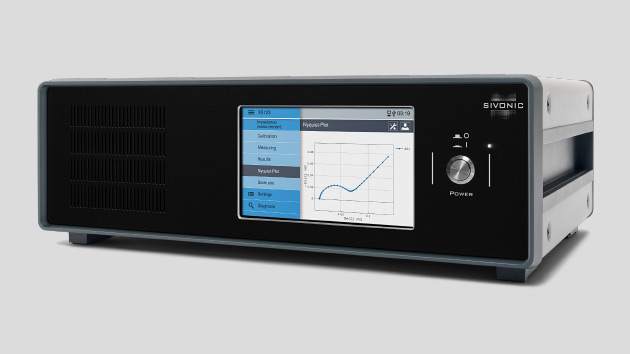

SIVONIC has published a new Technical Note on the combined application of Distribution of Relaxation Times (DRT) and Harmonic Ratio Analysis (HRA).
DRT assigns changes in the linearized electrochemical system response to specific relaxation-time ranges. HRA complements this information by evaluating selected features of the nonlinear response. Their combined use is particularly valuable when different fault conditions produce similar impedance changes or remain inconspicuous in conventional DC voltage measurements.
The Technical Note examines two relevant differential-diagnostic cases:
- PEM fuel cells: CO poisoning versus dehydration and flooding
- PEM electrolyzers: H₂ crossover versus two-phase and gas-accumulation conditions
A particular focus is placed on load-dependent, multi-channel measurements at cell or cell-group level. Local changes may be diluted in the total stack voltage or remain within the natural variation of conventional cell-voltage measurements. Channel-resolved DRT and HRA therefore add a spatial information layer and help localize anomalous stack regions.
The publication also defines the limitations of the approach. Individual DRT peaks or harmonic ratios are not universal fault indicators. Reliable interpretation requires platform-specific reference ranges, controlled measurement quality, and the combined assessment of load dependence, spatial patterns, temporal persistence, and targeted operating interventions.
For safety-critical conditions such as H₂ crossover, direct gas, pressure, temperature, and protective sensing remain essential. Following platform-specific validation, DRT and HRA can complement these measurements as electrical early-warning, localization, and differential-diagnostic methods.
Authors: Hannes Benecke and Robert Benecke
Published: 2 August 2026
DOI: 10.5281/zenodo.21762110
The full publication is available via the following link: https://zenodo.org/records/21762110
![[Translate to Englisch:] SIVONIC_HRA_DRT](/fileadmin/_processed_/8/4/csm_HRA_DRT_d67703a4da.png)